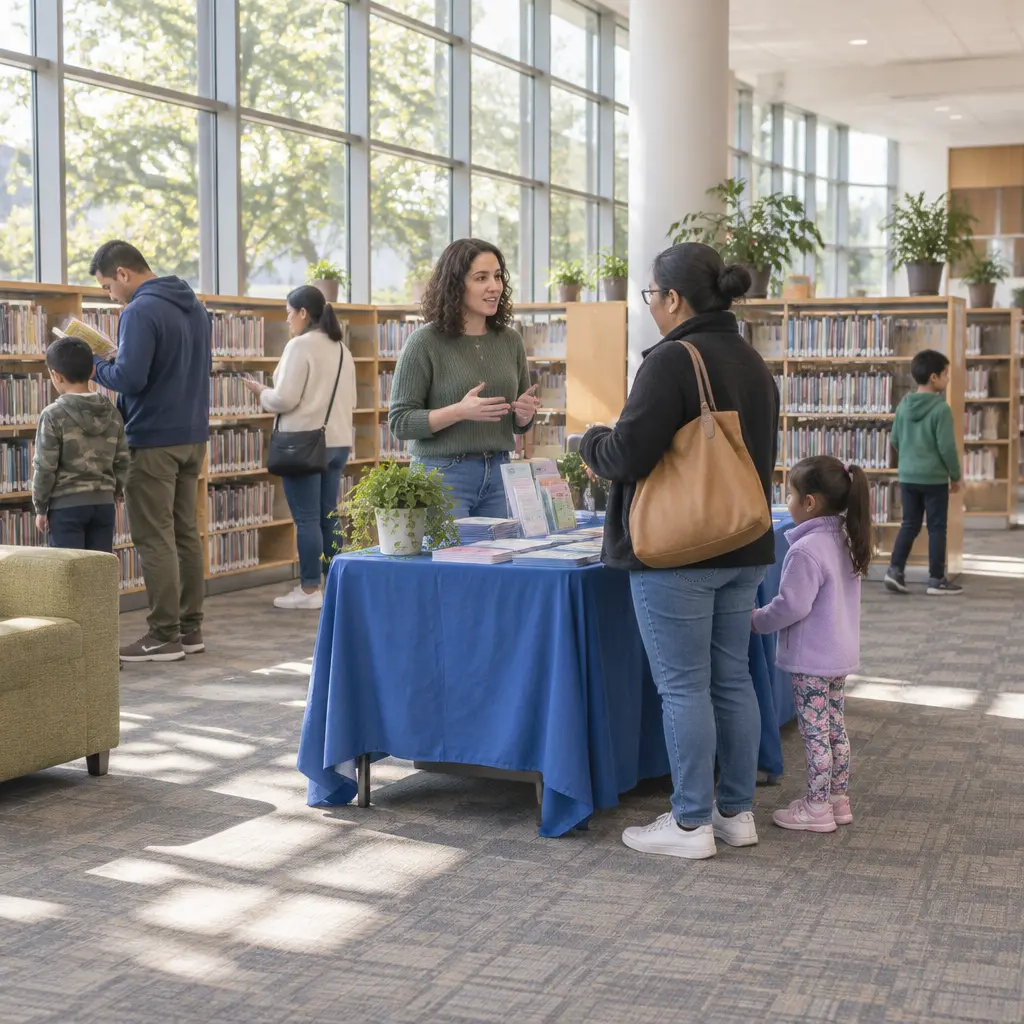
Community outreach works best when organizations meet families in places they already visit and trust—such as schools, libraries, faith communities, parks, clinics, and neighborhood events. This approach, often called place-based or community-centered outreach, reduces practical barriers and creates opportunities for sustained relationships. The need is substantial: the U.S. Census Bureau reported that 17.9% of U.S. children lived in poverty in 2022, while the U.S. Department of Agriculture reported that 13.5% of U.S. households experienced food insecurity in 2023. By partnering with familiar gathering places, outreach teams can make information and services easier to find, adapt programs to local needs, and measure whether families are being reached equitably.
Build Community Outreach Around Trusted Gathering Places
Community outreach is the planned process of connecting people with information, support, services, and opportunities for participation beyond an organization’s usual setting. The Centers for Disease Control and Prevention (CDC) describes community engagement as working collaboratively with groups connected by geography, shared interests, or similar circumstances to address issues affecting their well-being. In practice, outreach that meets families where they already gather applies that principle by bringing useful, respectful, and accessible support into familiar settings.
This approach matters because the distance between a service and the people who need it is not only physical. Transportation, work schedules, childcare, language access, disability access, unfamiliar institutions, and uncertainty about eligibility can all deter participation. The U.S. Census Bureau’s 2022 poverty data and the USDA’s 2023 food-insecurity data illustrate why accessible connections to assistance remain important. Those national figures do not show how many families any individual outreach program will reach; local needs assessments are essential for making that determination.
Define Community Outreach Through Family-Centered Access
Family-centered community outreach is an approach that brings information, resources, and opportunities to participate into places families already use, while involving residents and local partners in deciding how outreach is designed. The CDC’s principles of community engagement emphasize relationships, collaboration, and attention to the community’s context. Accordingly, outreach is more than distributing brochures: it includes listening, reducing access barriers, providing useful next steps, and following up appropriately.
Related forms include place-based outreach, school-family engagement, mobile service delivery, community health outreach, and culturally and linguistically responsive engagement. These approaches overlap, but each emphasizes a different route to access. A school may provide a recurring connection with caregivers; a mobile service may bring screening or enrollment assistance to a neighborhood event; and a community health worker may link residents to care while building trust over time.
Trusted Locations and Familiar Relationships
A trusted gathering place is a setting people already visit and recognize as relevant to their everyday lives. Examples include schools, early-childhood centers, public libraries, places of worship, community centers, clinics, food-distribution sites, parks, and neighborhood festivals. The location alone does not guarantee trust: families’ experiences with the host organization, the presence of familiar staff, privacy protections, and the way services are offered all shape whether people feel comfortable taking part.
The Institute of Medicine’s report The Future of the Public’s Health in the 21st Century describes community partnerships as an important part of public health practice. That principle applies broadly: local organizations can offer knowledge of neighborhood needs, established relationships, and practical insight into timing and communication. Outreach teams should ask partners and families which locations are genuinely convenient and welcoming rather than assume that a commonly used venue serves every group equally well.
Reducing Practical Barriers to Participation
Accessible outreach reduces the effort required to learn about or use a service. Useful measures may include offering events at multiple times, providing interpretation and translated materials, selecting sites reachable by public transportation, accommodating mobility and sensory needs, and making clear whether registration or identification is required. Where appropriate, teams can combine outreach with enrollment help, referrals, health checks, or child-friendly activities so families can address more than one need during a visit.
The USDA’s 2023 report,
Choose Outreach Settings That Match Family Routines
Once the access principle is clear, the next step is choosing locations and formats that fit local routines. A suitable site is not simply one with high foot traffic; it should be relevant to the families being served, accessible, safe, and supported by a partner willing to coordinate. Combining several locations can also reach families who do not regularly use any single institution.
Schools and Early-Childhood Programs
Schools and early-childhood programs provide recurring contact points for caregivers, children, and staff. Outreach may include family resource nights, application assistance, workshops, interpretation-supported conferences, or referrals to local services. The National Center for Education Statistics reported approximately 49.6 million students enrolled in public elementary and secondary schools in fall 2022, underscoring the reach of school systems as potential partners. Enrollment does not mean every family is equally reachable through school channels, so programs should also account for families with irregular attendance, limited digital access, or children outside public schools.
Libraries, Faith Communities, and Community Centers
Libraries, faith communities, and community centers often host activities across age groups and provide spaces for learning, conversation, and referrals. They can be useful venues for resource fairs, benefits-navigation sessions, parent groups, and multilingual information events. A partner’s role should be agreed upon in advance: clarify who will provide information, protect confidential details, manage referrals, and respond if families request help beyond the event’s scope.
The American Library Association’s annual public-library data document the extensive reach of library services across the United States. Libraries can therefore serve as practical partners for family information and digital-access support. However, outreach should not assume that a library or faith community represents everyone in a neighborhood; partnerships with multiple organizations help broaden access and avoid treating any single institution as a proxy for the whole community.
Parks, Markets, Clinics, and Neighborhood Events
Outdoor events, farmers markets, clinics, and neighborhood festivals can reach people who may not attend formal workshops. Short conversations, demonstration activities, mobile enrollment assistance, and clear referral cards can fit these settings better than lengthy presentations. For services involving sensitive information, teams should offer a private conversation area and avoid collecting personal data in public view.
The CDC’s Community Health Worker resources describe community health workers as trusted frontline public health workers who have a close understanding of the communities they serve. When appropriately trained and supported, they can help connect event-based introductions with ongoing services. A one-day event is most useful when it leads to a named contact, a clear referral pathway, or a follow-up option families can choose.
Design Outreach With Families and Community Partners
Choosing a venue is only one part of an effective program. Strong outreach also depends on shared planning, respectful communication, and a reliable process for turning a conversation into support. The CDC’s community-engagement guidance emphasizes collaboration rather than one-way delivery, making resident input a core element of program design rather than an optional final review.
Listen Before Planning
A local needs assessment gathers information from families and community partners about priorities, preferred locations, barriers, and existing resources. It can include listening sessions, short surveys, interviews with service providers, and review of public data. Ask specific, practical questions: What time works? Which languages are needed? What makes a service feel safe? What support would make it easier to return?
The U.S. Census Bureau’s American Community Survey can help identify local characteristics such as household composition, language spoken at home, income, and transportation access. These data describe populations, not individual preferences. Combining them with direct community input helps prevent organizations from making assumptions based on demographic statistics alone.
Use Clear, Culturally Responsive Communication
Culturally responsive communication presents information in ways that respect families’ languages, experiences, and preferences. It includes plain language, accurate translation, interpretation when needed, and messages reviewed by community members. It also means explaining what a service can and cannot provide, how information will be used, whether participation is voluntary, and what happens after a referral.
The U.S. Department of Health and Human Services’ National Standards for Culturally and Linguistically Appropriate Services in Health and Health Care call for effective, understandable, and respectful services responsive to cultural health beliefs and communication needs. Although developed for health and health care, the standards offer useful guidance for family outreach in other fields as well. Translated materials alone are not enough if the event lacks interpretation, accessible formats, or staff able to answer questions.
Build a Reliable Referral and Follow-Up Path
A referral pathway explains how families move from an initial conversation to the service they need. Effective pathways identify a responsible contact, confirm the family’s preferred method of communication, clarify consent, and make it possible to learn whether the connection succeeded. Follow-up should be timely and proportionate, with privacy safeguards and no pressure to disclose information a family does not wish to share.
The CDC’s Framework for Program Evaluation in Public Health recommends using evaluation to improve programs and support decisions, with attention to stakeholders and context. For outreach, that means looking beyond attendance counts. Teams can track whether families received requested information, completed referrals, returned for services, and reported that the experience was respectful and useful.
Measure Reach, Quality, and Lasting Community Benefit
Measurement helps organizations distinguish a busy event from an effective outreach effort. A practical evaluation combines counts with feedback and outcome measures, while protecting privacy and avoiding unnecessary data collection. Results should be reviewed with community partners so that families’ experiences help shape improvements.
Track Reach and Access
Reach measures who encounters outreach and whether the intended population is represented. Teams can record attendance, location, event time, requested language, service type, and referral volume, using only the information needed for evaluation. Where lawful and appropriate, aggregate results can be compared with local population data to identify gaps. Attendance alone does not reveal whether a family received help or felt comfortable participating.
Assess Experience and Service Connections
Quality measures whether outreach is understandable, respectful, accessible, and useful. Brief anonymous feedback, partner debriefs, referral-completion rates, and repeat participation can reveal where a process works or breaks down. For example, a high number of referrals paired with few completed connections may indicate that families need transportation help, simpler procedures, or a warm handoff rather than another information sheet.
Share Findings and Improve the Program
Community partners should receive a clear summary of what the outreach achieved, what barriers emerged, and what will change next. Sharing findings strengthens accountability and recognizes that families and partners contribute time and local expertise. A simple visual dashboard or chart can compare attendance, referral completion, and participant feedback across locations or event types, provided that small groups cannot be identified from the data.
Conclusion: Make Community Outreach a Continuing Relationship
Community outreach that meets families where they already gather combines trusted locations, reduced access barriers, family-informed planning, culturally responsive communication, and dependable follow-up. Schools, libraries, faith communities, clinics, parks, and neighborhood events can all serve as useful entry points when they fit local routines and are connected to real services. National indicators—including child poverty and household food insecurity—reinforce the importance of accessible support, while local listening and evaluation determine what works in a particular community.
Organizations can begin by asking families and community partners where, when, and how they want to connect; selecting one or more welcoming sites; establishing clear referral and privacy procedures; and measuring outcomes beyond attendance. Treat outreach as an ongoing partnership, not a one-time event. For further guidance, consult the CDC’s community-engagement and evaluation resources, the U.S. Census Bureau’s American Community Survey, and the USDA’s household food-security reports.
Sources: Centers for Disease Control and Prevention, Principles of Community Engagement, 2nd Edition, https://www.atsdr.cdc.gov/communityengagement/pdf/PCE_Report_508_FINAL.pdf; U.S. Census Bureau, Income and Poverty in the United States: 2022, https://www.census.gov/library/publications/2023/demo/p60-280.html; U.S. Department of Agriculture, Household Food Security in the United States in 2023, https://www.ers.usda.gov/publications/pub-details?pubid=109895; Institute of Medicine, The Future of the Public’s Health in the 21st Century, https://nap.nationalacademies.org/catalog/10548/the-future-of-the-publics-health-in-the-21st-century; National Center for Education Statistics, Digest of Education Statistics, Table 203.10, https://nces.ed.gov/programs/digest/d23/tables/dt23_203.10.asp; American Library Association, Public Library Data, https://www.ala.org/tools/research/librariesmatter/public-library-data; Centers for Disease Control and Prevention, Community Health Workers, https://www.cdc.gov/chronic-disease/about/community-health-workers.html; U.S. Census Bureau, American Community Survey, https://www.census.gov/programs-surveys/acs; U.S. Department of Health and Human Services, National Standards for Culturally and Linguistically Appropriate Services in Health and Health Care, https://thinkculturalhealth.hhs.gov/clas; Centers for Disease Control and Prevention, Framework for Program Evaluation in Public Health, https://www.cdc.gov/mmwr/preview/mmwrhtml/rr4811a1.htm.